
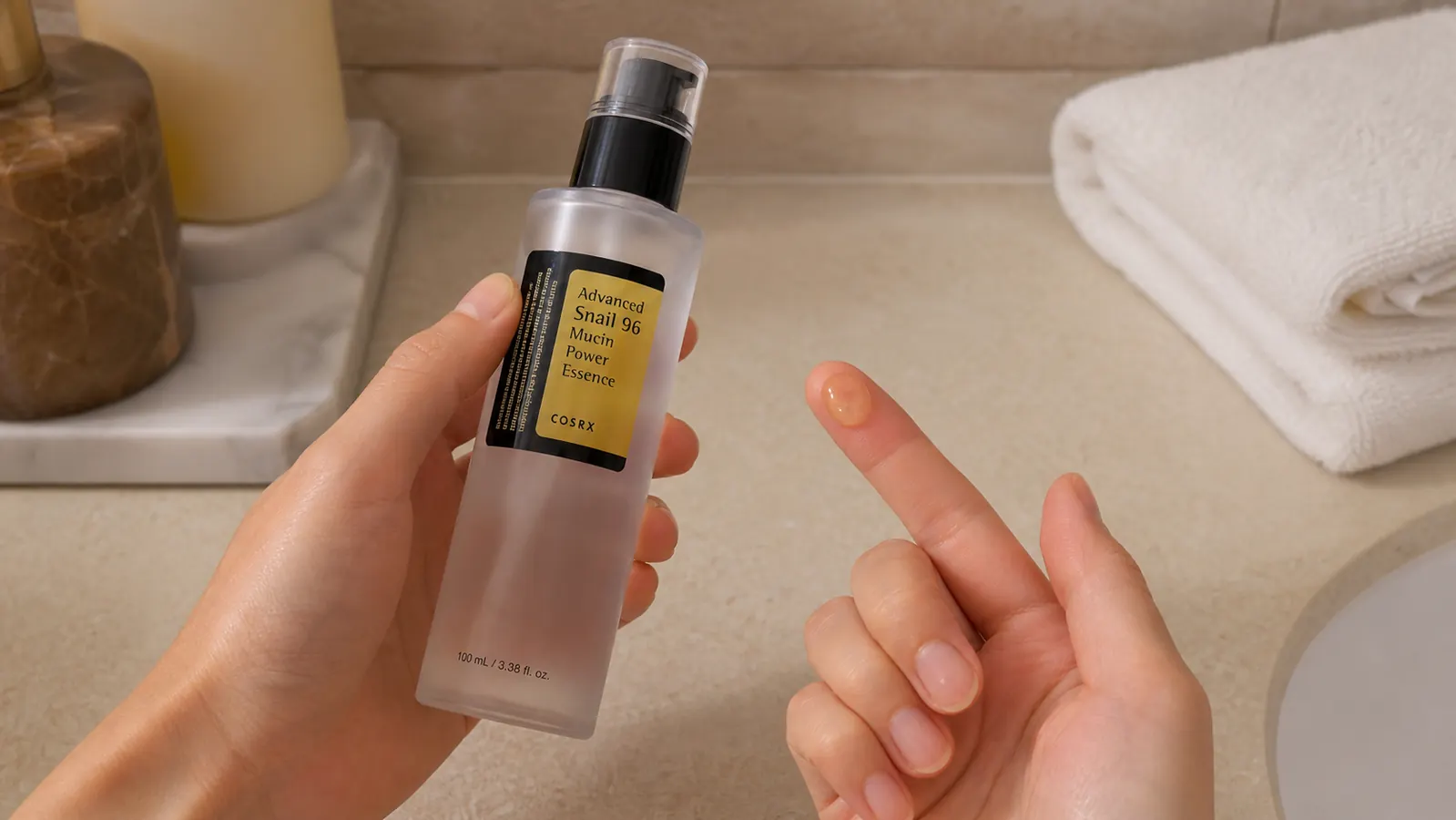
A few months ago I had both bottles sitting on my shelf at the same time: the COSRX Snail Mucin 96% Repairing Serum, which I have been reaching for since I first got into K-beauty, and a PDRN serum that a dermatologist friend kept mentioning. I used them in alternating weeks, same routine otherwise, tracking how my skin felt and looked. The short answer: they are not really competing. They do different things. But if you can only buy one right now, there is a clear winner for most people, and it is not the expensive new one.
COSRX Snail Mucin 96% is affordably priced on Amazon and has over 104,000 reviews. The medicube PDRN Pink Peptide Serum, which is one of the more accessible PDRN options on Amazon, runs about the same price but with a much shorter track record. For barrier repair and daily hydration at this price point, snail mucin is still the more proven, more versatile choice. PDRN earns its spot in more targeted renewal routines. Here is the full breakdown.
| COSRX Snail Mucin 96% | PDRN Serum (e.g. medicube) | |
|---|---|---|
| Key active ingredient | 96% Snail Secretion Filtrate (SSF) | Polynucleotides (PDRN) + peptides |
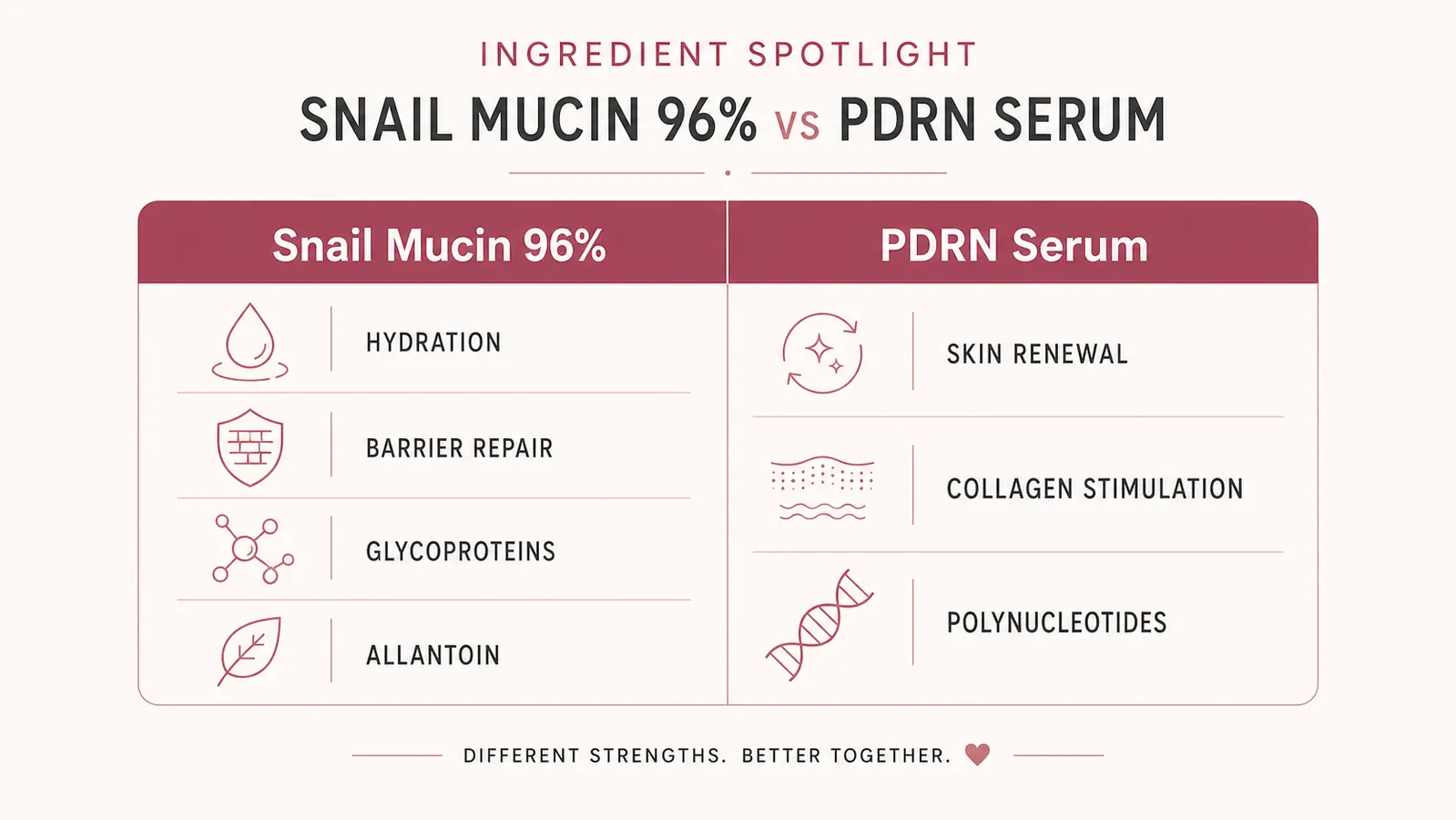
| Primary mechanism | Barrier repair, hydration, wound healing via allantoin and glycoproteins | Skin cell renewal and collagen stimulation via DNA fragment signaling |
| Best skin concern | Damaged barrier, redness, dehydration, post-acne marks | Fine lines, dullness, uneven texture, skin renewal after procedures |
| Texture | Thin, slightly tacky gel; nearly weightless | Lightweight watery serum; quick-absorbing |
| Suitable for sensitive skin | Yes, very gentle; minimal ingredient list | Generally yes, but formula complexity varies by brand |
| Amazon reviews | 104,474 reviews, 4.5 stars | 16,108 reviews, 4.4 stars (medicube) |
| Price (current) | Check today's price on Amazon | Budget-friendly, varies by brand |
| Speed of visible results | Hydration within days; barrier improvement over 2-4 weeks | Skin texture improvements typically 4-8 weeks |
| Best for layering | Works under moisturizer, pairs with niacinamide, ceramides, retinol | Pairs with peptide serums and SPF; avoid AHAs on same step |
Still patching a damaged barrier with products that were not built for it?
The COSRX Snail Mucin 96% Repairing Serum is what 104,000 shoppers reached for when other serums stopped working. It is gentle enough for daily use, affordable enough to keep stocked, and ingredient-simple enough to layer with almost anything.
Amazon Check Today's Price on Amazon →Where COSRX Snail Mucin 96% Wins
The core strength of snail mucin serum is the ingredient itself. Snail Secretion Filtrate is a complex biological fluid that contains hyaluronic acid, glycoproteins, proteoglycans, allantoin, and antimicrobial peptides, all in one naturally occurring package. At 96% concentration, the COSRX formula is almost nothing but the active. The rest of the ingredient list is nine items long, which is unusually minimal for a K-beauty serum and exactly what reactive or barrier-damaged skin needs.
Allantoin in particular is a known skin-soothing and wound-healing compound. That is why snail mucin serums have such a strong track record for post-acne marks and micro-damage from over-exfoliation. It is not just hydrating the skin surface, it is signaling repair at the barrier level. I noticed this most clearly when my skin was going through a rough patch after I had been testing a strong retinoid: two weeks of morning snail mucin application and the tightness and flaking were visibly reduced.
The other win is consistency and availability. COSRX has been selling this formula since 2014. The ASIN on Amazon has over a decade of real-world data behind it, the formula has not changed, and counterfeit reports are rare compared to some other K-beauty bestsellers. When you buy it, you know exactly what you are getting. That kind of stability matters when you are trying to build a repeatable routine rather than chase whatever ingredient went viral this month.
Where PDRN Serum Wins
PDRN stands for Polydeoxyribonucleotide, which is a fragment of DNA typically derived from salmon sperm (or vegan-synthesized alternatives). In clinical dermatology, PDRN is used in injectable form for skin repair after procedures. The idea behind topical PDRN serums is that the smaller molecular fragments can signal fibroblast activity and support collagen production in a way that traditional humectants simply cannot replicate.
If your concern is fine lines, loss of firmness, or post-procedure skin renewal, the theory behind PDRN is genuinely compelling. The medicube PDRN Pink Peptide Serum pairs PDRN with niacinamide and peptides, which adds a brightening and firming layer that snail mucin alone does not address as directly. For women in their mid-30s and up who have a stable barrier and want to target skin texture and early signs of aging, a PDRN serum is worth adding to the mix.
PDRN also has a psychological advantage for people who like to feel they are doing something proactive about aging. The ingredient story is backed by real dermatological research, even if the topical delivery question remains open. Compared to more aggressive actives like retinol or strong exfoliants, PDRN is a low-risk way to address renewal concerns. It very rarely causes irritation, and it plays well with most other K-beauty products in your stack.
Snail mucin is the firefighter. PDRN is the architect. Your skin usually needs the firefighter first.
Ingredient Deep-Dive: What Each One Is Actually Doing
Snail Secretion Filtrate works at the surface and barrier level. The glycoproteins act as a film-forming humectant, pulling water into the skin and slowing transepidermal water loss. Allantoin accelerates cell turnover and wound healing. The antimicrobial peptides help keep breakout-causing bacteria in check, which is why snail mucin serums are so popular for acne-prone skin. You are getting hydration, repair, and mild anti-inflammatory action all from one ingredient.
PDRN operates through a different pathway. The polynucleotide fragments are thought to bind to adenosine A2A receptors in skin cells, triggering a healing and regeneration cascade. In injectable form, this is well-documented in clinical literature. For topical application, the science is more nuanced because molecular absorption through intact skin is harder to guarantee. Brands address this by keeping molecular weights low or using liposomal delivery systems. Whether the topical version matches the injectable results is still being studied, but the ingredient rationale is solid enough that leading Korean dermatologists have incorporated it into their topical recommendation lists.
The practical upshot: snail mucin gives you reliable, measurable barrier and hydration results starting in the first week. PDRN gives you a credible renewal mechanism with results that build over four to eight weeks. Neither is hype. They just operate on different timelines and address different problems. Trying to compare them directly is a bit like asking whether you should eat breakfast or take your vitamins. Both have a job. The question is which job your skin needs done right now.
Texture and Layering
COSRX Snail Mucin has a slightly thick, gel-like consistency. It is nearly clear with a faint amber tint. It feels a little tacky for a few minutes after application, then settles into the skin and disappears completely. It layers beautifully under a moisturizer and does not pill even under heavy creams or sunscreen. One thing to note: if you apply it over a toner with a high alcohol content, you will feel the tackiness more. I always use it on slightly damp skin after a water-based toner for the smoothest finish.
PDRN serums vary by brand, but the medicube version has a more watery, lightweight texture that absorbs almost instantly. There is no tackiness. It layers well under both snail mucin and heavier serums, which is why many people use PDRN as a first serum step in a routine that then builds up with snail mucin and a cream on top. If you are piling on multiple actives, PDRN tends to be the least likely to cause pilling or friction in your layering stack.
Who Should Buy Which
Buy COSRX Snail Mucin 96% if your skin is reactive, barrier-compromised, or prone to dehydration and post-acne marks. This is also the right starting point if you are newer to K-beauty serums and want something proven and gentle before you commit to more active ingredients. The short ingredient list means very few people react to it, and the current price makes daily use completely sustainable without feeling like you are burning through something precious.
Buy a PDRN serum if you already have a stable, healthy barrier and your focus is on renewal and anti-aging rather than repair. Think of it as a step up in your routine, not a replacement. The best approach I have seen is using PDRN in the morning, snail mucin at night, and letting each one do its job in the time window where it performs best. If budget is a constraint, start with snail mucin. Add PDRN later.
One group that should lean strongly toward snail mucin: anyone who has recently been using a retinoid, chemical exfoliant, or going through a purge phase. PDRN is not a calming ingredient in the way snail mucin is. When your skin is in active repair mode, snail mucin is the more effective and more gentle choice. Reach for PDRN once your skin is stable and you are chasing improvement rather than recovery.
The Verdict
COSRX Snail Mucin 96% wins this comparison for most people most of the time. It is more versatile, faster-acting for the concerns that affect the widest range of skin types, and has a real-world track record spanning over a decade and 100,000 reviews. The 96% concentration means you are getting a meaningful dose of the active, not a trace amount dressed up with marketing copy. At its current price, it is one of the most defensible buys in all of K-beauty.
PDRN serum is not a loser here. It earns its place in a mature, stable routine where you are targeting renewal and texture at a deeper level. It is the smarter add-on once your barrier is in good shape. Think of this less as a competition and more as a sequence: snail mucin first, PDRN when you are ready to take the next step. If you want to go deeper on each product individually, the full long-term reviews for both are linked below.
The serum 104,000 people use when their skin needs a reset.
COSRX Snail Mucin 96% Repairing Serum. No fillers, no fragrance, no unnecessary actives. Just 96% snail secretion filtrate working on your barrier from the first application, at a price that makes daily use an easy yes.
Amazon Check Today's Price on Amazon →